

The decision matters more than most B2B tech marketing leaders realize
Finding the right external visual content supplier is one of the most consequential decisions a B2B tech marketing leader makes — and it rarely gets the rigorous evaluation it deserves.

The technology you’re marketing is complex, layered, and genuinely innovative. The buyer is sophisticated, distracted, and increasingly hard to reach. The channels keep multiplying — video, interactive, long-form, sales enablement, events, ABM, web, social — each with its own craft requirements and deadlines. The pressure to make your technology genuinely understood, not just seen, has never been higher.
Get the supplier right, and your technology lands with the buyer the way it deserves to. Get it wrong, and you’re producing content at scale that looks professional, stays on brand, and quietly fails to move the needle. The buyer sees it. They just don’t get it.
Switching suppliers is also a real undertaking — new relationships, new processes, new briefs, new workflows. Since you’re already absorbing that disruption, it’s worth making the decision count. That means applying a sharper framework than most B2B tech marketing leaders typically use.

Why doesn’t the supplier market offer much relief?
Most B2B tech marketing organizations rely on three options, each with a structural limitation.
Internally, most teams have a brand graphics function that maintains templates, manages approved assets, and enforces brand compliance. They’re often good at that. But they’re not built to do upstream content development for complex technology — the default is to pull from the approved, increasingly AI-augmented image library and overlay text.
Externally, most suppliers are single-craft shops. An animation studio that’s good at what it does. An infographic shop that’s good at what it does. A slide designer who’s good at slide design. Each one needs complete direction from you to know what to produce. No one has the depth in B2B tech marketing to develop the narrative themselves — so the thinking still has to come from your side.
Or you hire a big brand agency. Most are built around consumer aesthetics. The work is polished, on-brand, and strategically thin because unpacking complex technology was never their craft. They’re brand reinforcers, not explainers.
Given these options and the calendar pressure you’re under, the compromise is predictable: stock-with-text-overlay, produced internally or externally, covers the calendar. It just doesn’t explain the technology at the depth your buyer needs. That’s not a failure of judgment — it’s a structural failure of the supplier market itself, which is exactly why it’s worth evaluating suppliers against a framework rather than defaulting to whoever’s available.
Part One: The traditional fit criteria
These are foundational. Any serious B2B tech visual content supplier should satisfy them — necessary, but not sufficient. Think of this as the filter that narrows the field to legitimate contenders.
B2B tech specialization. Non-negotiable. You want a supplier whose entire practice is built around B2B technology marketing, not a generalist creative agency that has done a few tech accounts. B2B tech marketing has its own language, its own buyer psychology, its own content conventions, and one particular challenge: making genuinely complex, innovative technology understood by a sophisticated and skeptical buyer. A shop that dabbles in tech will produce work that looks competent but misses the nuance.
Client roster and portfolio depth. The client list tells you whether a supplier has operated at the level your program demands — enterprise technology clients with complex offerings and high standards. The portfolio tells you whether the work is genuinely sophisticated: does it clearly and compellingly unpack complex technology, or does it just look good?
Full output range. B2B tech marketing programs are integrated and multichannel. You need explainer videos, sales decks, infographics, trade show materials, interactive web content, ebooks, sales enablement tools, and social assets — ideally from one supplier under one roof. Fragmented suppliers produce fragmented visual stories.
Reliable process and delivery. Quarterly content demands don’t wait. You need a proven process that delivers consistently without requiring you to manage the relationship intensively. Table stakes, but worth verifying explicitly.
If a supplier clears all four, you have a legitimate contender. There’s a fifth criterion, though — the one most marketing leaders don’t apply rigorously enough — that separates truly exceptional suppliers from merely capable ones.
Part Two: The explanation approach
This is the most important criterion, and the one that gets the least scrutiny in most supplier evaluations.
Here’s the uncomfortable truth about the B2B tech visual content industry: most external suppliers, even specialized ones, are built on the same fundamental approach as your internal graphics department. Stock images. AI-augmented generic imagery. Templates, formatted and branded to look professional, are delivered efficiently at scale.
The format varies — that same stock-image foundation can arrive as an animated explainer video, a designed infographic, a formatted sales deck, or a produced ebook. Production values are higher than those of an internal team. The underlying explanation problem is identical.
Stock images and AI-augmented visuals are built for scale and cost efficiency. They are not built to unpack the specific innovation, differentiation, and value of a complex enterprise technology for a sophisticated buyer. They decorate. They don’t explain. For a company whose market position depends on buyers genuinely understanding what makes the technology different, decoration is an expensive form of failure.
Most marketing leaders know this on some level — they’ve seen it in the metrics, heard it from sales, felt the gap between how good the technology actually is and how well it lands in market. They’ve just accepted it as an inevitable cost of operating at scale across multiple channels every quarter.
It isn’t inevitable. It requires a different supplier approach.
What the right approach looks like
The right supplier doesn’t start with a stock image library or an AI prompt. They start with a blank page.
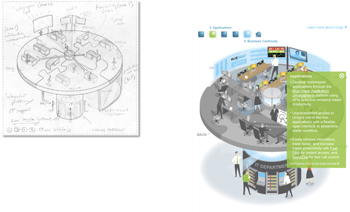
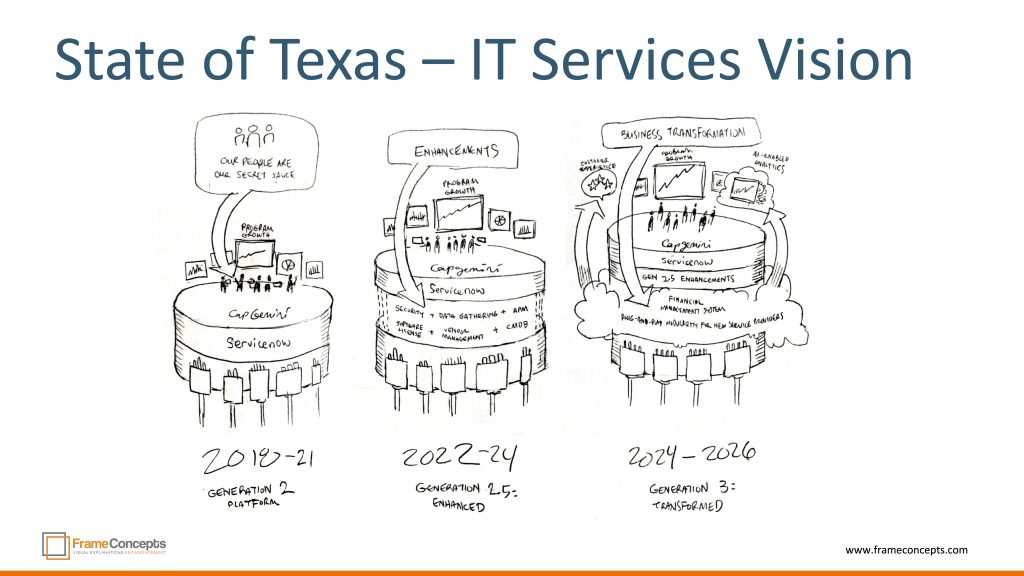
A B2B tech marketing veteran and a professional concept artist sit down with your technology, your buyer, your competitive differentiation, and your marketing goals. They challenge the brief, develop the content strategy, and ask the questions your internal team is too close to the technology to ask. From there, they build an original illustrated visual narrative — engineered specifically to unpack the complexity, make the innovation understood, and engage the buyer you’re trying to reach.
That original storyboard becomes the foundation for every output the program needs: explainer video, sales deck, trade show kiosk, ebook, infographic, social assets — all flowing from the same original visual thinking, all carrying the same explanatory power, all consistent in story and positioning across every channel and touchpoint.
Because the hard thinking — the original storyboard — happens once and then carries over into every output, the economics work. You’re not rebuilding the visual story from scratch for every asset. One original investment, every output. And ideally, the same concept artist who built the storyboard oversees every deliverable through to completion, so the explanatory power conceived and approved arrives intact in the final animation, the final deck, and the final event poster.
This is what makes technology genuinely understood rather than merely decorated — and it’s the criterion most marketing leaders skip. They check the traditional fit boxes, review the portfolio, agree on outputs, and sign the contract. Then they wonder why the content looks good but doesn’t move the needle.

Applying the framework
When you evaluate your next visual content supplier — or benchmark your current one — apply both parts with equal rigor.
The traditional fit criteria narrow the field to legitimate contenders: B2B tech specialization, a client roster and portfolio to prove it, a full range of output under one roof, and a reliable delivery process. The explanation approach identifies which of those contenders is actually equipped to solve the real problem — making complex, innovative technology genuinely understood by your buyer, at scale, across every channel, every quarter.
Most suppliers pass part one. Very few pass part two.
A disclosure worth making
I’m the founder of Frame Concepts, a B2B tech visual content agency I started in 2010. Everything described in this framework — the blank-page storyboard approach, the concept-artist-led process, the full range of outputs, and sixteen years of exclusively B2B tech work with clients including HP, Cisco, Microsoft, GE, RSA, Dun & Bradstreet, Dell Consulting, and Entegris — is how we work.
I wrote this framework because I believe it reflects what good looks like in this category. The bias is real, and I won’t pretend otherwise. But the criteria hold regardless of who satisfies them — run any supplier you’re evaluating, including us, against both parts of them.
If you’re currently evaluating visual content suppliers and want to talk through whether Frame Concepts is the right fit for your technology and programs, reach out for a live consultation.