

FRAME CONCEPTS
Why the fastest and most economical approach to visual content production may be the most expensive decision a B2B tech marketing program makes.
The task is uniquely demanding.
B2B tech marketing has a uniquely demanding task. Taking genuinely complex technical innovation and translating it into content that works across every channel, every program, and every buyer touchpoint — from early awareness through to sales enablement and close.
That task is getting harder. Solutions are more complex. Competition is more intense. Marketing channels are multiplying. And the business buyer of technology is more distracted and time-pressed than ever, with less patience for content that doesn’t immediately show them the point and value of what they’re evaluating.

The practical response — and why it persists
Against that backdrop, most B2B tech marketing programs are producing visual content under real budget and time constraints. The practical response has been to scale content with stock images and, more recently, AI-augmented graphics. They’re fast, accessible, and economical to produce.
The approach persists for understandable reasons. It’s a decades-old tradition borrowed from consumer marketing, where visual imagery works differently. It’s what every competitor does. Non-marketing colleagues and management respond positively to content that looks polished and well-designed. And the connection between the visual content approach and buyer engagement outcomes is rarely examined directly.
The irony at the heart of the approach
There is an irony at the heart of how most B2B tech marketing programs produce visual content. Stock images and AI augmented graphics are chosen because they’re fast and economical to produce — optimizing for the marketing team’s time. But they transfer the entire explanatory burden onto the buyer. Who must now work harder, read more carefully, and spend more time trying to understand something that was never made visually clear. A distracted and time-pressed business buyer who has to work to understand a solution will disengage. The content saved time on one end but lost the buyer on the other.

Whose time matters more to a B2B tech enterprise? The marketing team’s — or the buyer’s?
Of course, it is the buyer. Every commercial outcome depends on it. It means investing the marketing team’s time upfront to get the visual story right. Hence, the buyer’s journey through every touchpoint is clear, effortless, and engaging—rather than treating it as a cost. It’s the smartest allocation of time and resources for a B2B tech marketing program.
The approach that most B2B tech marketing leaders are not aware of
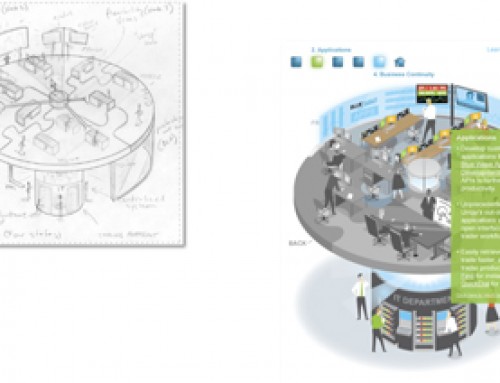
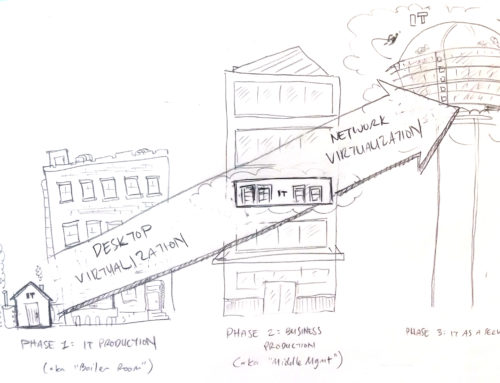
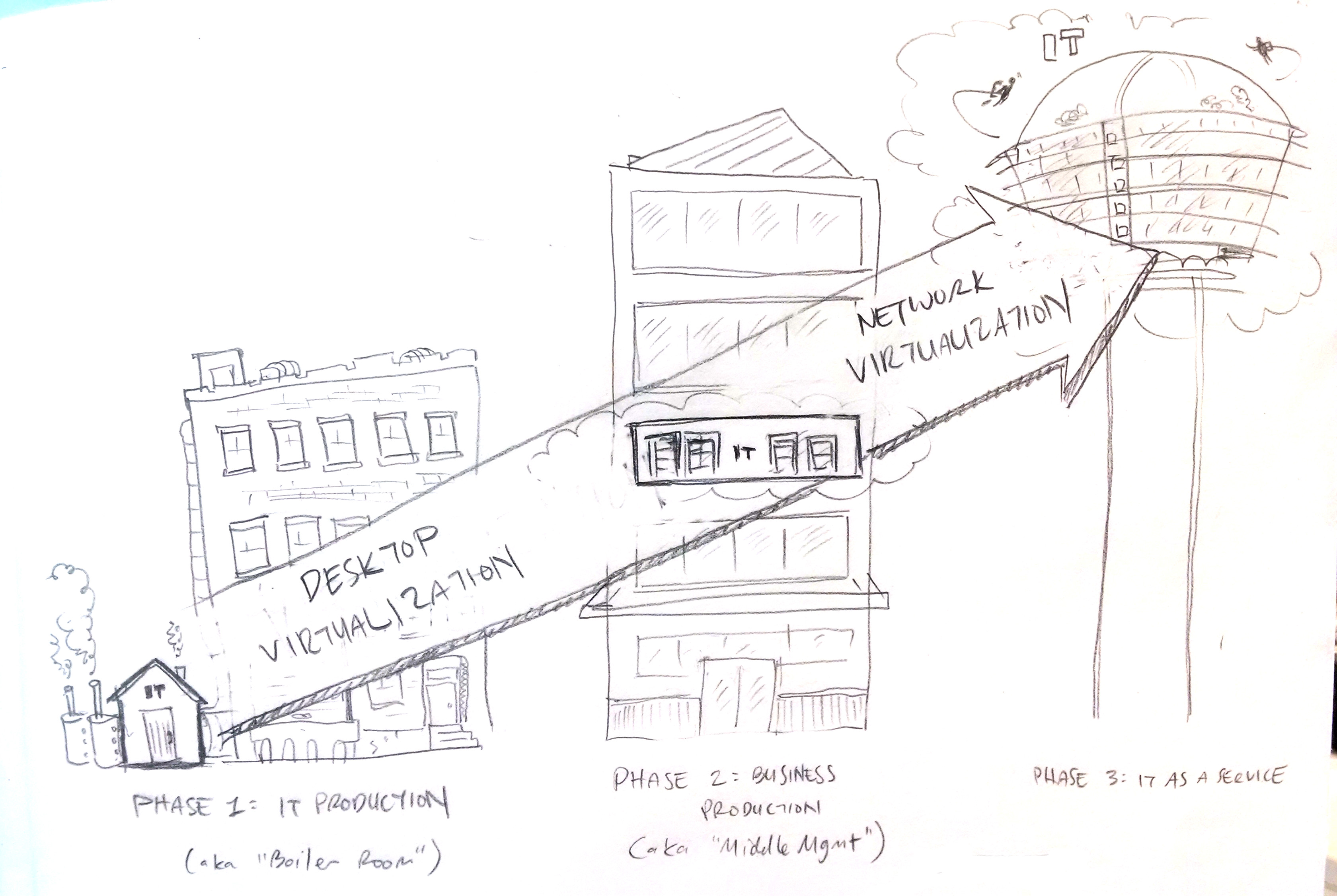
What most B2B tech marketing leaders are not aware of is that a fundamentally different approach exists. One where professional illustrators and information designers work from a blank page — through pencil sketch storyboards — to develop the core visual story that precisely unpacks the point and value of a complex technical solution. Making it immediately clear and engaging for the business buyer without requiring them to work through dense text and generic imagery to reach their own conclusion.
The blank-page storyboard approach inverts the logic of the stock-image approach. It invests the time upfront — professional illustrators iterating with stakeholders until the visual story precisely unpacks the point and value. That investment is recovered exponentially on the buyer side. Understanding happens immediately. Engagement follows without friction. The buyer’s time — the most valuable time in the entire commercial equation — is respected rather than consumed.

The budget concern — and why it misses the point
The instinctive response to such an approach is that original custom illustration must be prohibitively expensive compared to stock or AI-generated images. On a per-image basis, that’s true. But it misses the more important commercial logic.
The heavy strategic and creative investment happens once, at the storyboard stage. That core visual story then becomes the foundation for every content output, including Explainer videos. Solution pictograms. Pursuit pictograms. Sales presentations. Thought leadership ebooks. Buyer decision tools. Event visuals. Interactive prototypes. All transformed from the same storyboard origin by a full production team of illustrators, animators, and interactive programmers. The investment scales efficiently across everything. And because every output shares the same visual origin, the positioning stays consistent across every channel and every buyer touchpoint.

The more fundamental problem with stock images
More fundamentally — returning to the core task of B2B tech marketing — stock images are not designed to help buyers understand complex technical solutions. That was never their design intent.
The logical consequence of relying on them for that specific job is content that meets production requirements without actually explaining the solution to the buyer. In a market where buyers are time-pressed and distracted, content that doesn’t immediately show the point and value doesn’t get a second chance. The engagement doesn’t happen. And without engagement, the commercial outcomes don’t follow.

The only firm in the world specifically built to solve this problem
Frame Concepts is the only firm in the world specifically built to solve this problem. A pure B2B tech visual marketing firm where practitioners with decades of experience work exclusively on visually unpacking complex technical solutions for marketing programs.
The blank-page storyboard-first approach ensures the core visual story is precisely right before a single production asset is created. At Frame Concepts, we take every storyboard and turn it into the full range of content outputs a well-informed, multi-channel B2B tech go-to-market program needs—ensuring the right visual story reaches every buyer at every stage of their journey.
Frame Concepts – Sixteen years. HP. Microsoft. GE. Dell and a roster of the most demanding tech enterprises in B2B tech.